Tag: hot peppers

  • Nam Pla Prik

    nam pla prik

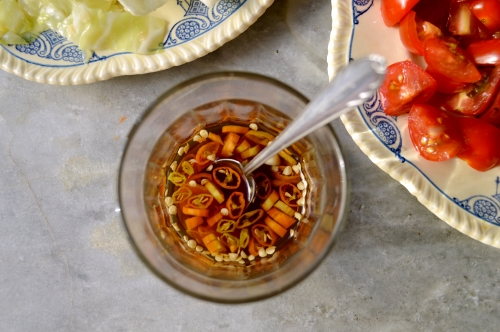
    I’ve heard nam pla prik (also sometimes called prik nam pla) referred to as the “salt and pepper” of Thai food. Only instead of salt, it’s fermented fish, and instead of black peppercorns, it’s extra spicy Thai bird’s eye chiles. For garlic-lovers like myself, some slices of raw garlic are added to the mix. And a little sugar helps balance the fish sauce (although it can be safely left out, too). Something so simple really shouldn’t be as addictive as the resulting sauce is. The key is, of course, the main ingredient – fish sauce (the “nam pla” in nam pla prik). I know, I know, it sounds weird and smells weirder, but I’ve come to love this pungent sauce made from fermented, salted fish that’s crucially important to Thai cuisine (and other Southeast Asian cuisines as well). Like salt, it brings out the flavor of whatever it’s added to, but it also adds complex umami (savory) notes. The bird’s eye chiles (which can be replaced with jalapenos for a milder version) give the sauce a kick – and (like all hot peppers) have great health benefits, including the ability to speed up your metabolism and high levels of vitamin C. Along with being a natural pairing to Thai dishes, nam pla prik is amazing over rice (or quinoa), eggs, or even just fresh vegetables.
    (more…)

    Related Posts:

  • Pickled Red Onions

    pickled red onions

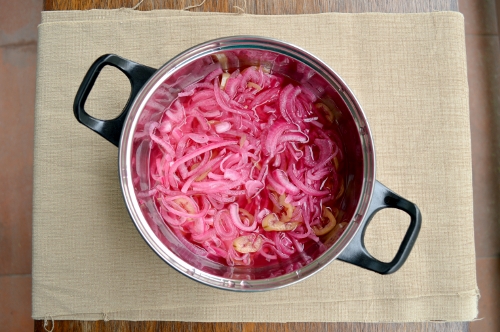
    The hardest part of moving, for me, is adapting to a new kitchen. Here, I only have a two-burner electric stove and a tiny sink (far too small for the amount of dirty dishes I produce), alongside a small square of counter space. I’m doing my best to adjust my habits, planning ahead to make sure I’ll have a burner free and being extra strict about cleaning dishes as I go. But, unlike my last place, there’s a full-sized refrigerator, so I have room again to stock up on little goodies like these pickled red onions. The onions still have a crunch to them and retain some of their characteristically strong taste, but the bite is mellowed by vinegar and sugar, with hot peppers tossed in to add a lingering kick of spiciness. They’re surprisingly addictive, and I find myself reaching for them over and over, an amazing addition to salads and sandwiches and great complement to all sorts of beans and meats. I like how versatile their simple flavor is, fitting in with a variety of cuisines – anything from Mexican (perch them atop tacos) to Indian (use as a side to balance rich curries) to Greek (sprinkle on a salad with feta). Although my favorite might just be snacking on them plain, something I can’t resist doing any time I open the refrigerator and spy them.

    (more…)

    Related Posts:

  • Habanero Infused Mezcal

    habanero infused mezcal

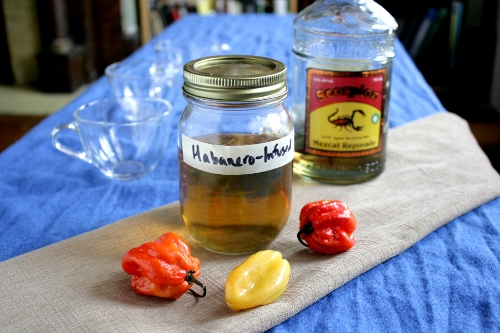
    I’ve recently become obsessed with mezcal. Similar to tequila, mezcal is made with agave, but the plant is roasted before distillation, lending a pleasantly smoky flavor to mezcal that is missing from tequila. Since I happen to love the flavors that are usually paired with tequila (lime and salt? Orange juice and grenadine? Yes, please!) and also anything smoky (bacon, good barbecue, smoked cheeses, smoked salt – all irresistible to me), it’s really not all that surprising that mezcal has grabbed my attention. Of course, I couldn’t resist taking things a step further and infusing my mezcal with habanero peppers for a spicy punch on top of the smokiness. The result is amazing with anything fruity although definitely not for those without a high spice tolerance. My habaneros may have been extra spicy (or maybe this was because I opted to only infuse half of my bottle of mezcal rather than the whole thing), but I actually needed less than 24 hours to reach a level that tested my (rather high) limits. So be careful to keep tasting the mezcal as it infuses so it doesn’t get too spicy. This technique can, of course, be used with tequila instead of mezcal and with different peppers instead of habaneros (although I like the fruity and citrusy notes they lend).

    (more…)

    Related Posts: